
Fungi are chlorphyllfreie organisms. The fungi live predominantly heterotrophic - from organic substances living and dead organisms. [3]
The essential growth-preconditions are in stock narrow coupled at this from water, which is required to the synthesis from cell-material and to the energy-production of the nutrients solved in the water. [3a] in our natural surroundings takes place a growth, if is available with a certain temperature, a sufficiently high relative dampness and the existence of the necessary food-substrates over a certain time-period.
If these conditions change, so the growth is restricted, these improve themselves again, so even seemingly perished Myzel can germinate again also after months. [4] goods life-conditions is available with a pH between 2 to 6,5 also until 8 and a temperature from 0ºC to +40ºC. Fungi prefer nutritional-media with low pHs broadly, bacterias prefer a neutral one on the other hand until alkaline area. Most organisms grow in a pH-area between 6-8 and are called neutrophil. The growth-speed of a cell depends on the pH of the surrounding medium. Also the metabolism-FTAM process can besides it, the cytomorphology, that composition of the wall cell and the cell-envelope and other influences. [12c] alter itself by leaps and bounds the pH (usually, already a value-alteration 1-2 is enough here) also only for one shorter time limit, so the growth-phase (exponential or in-patient grade) can turn very fast into an Absterbephase. In the fermentation-operation (technical manufacture of microorganisms), one names this pH-shocks. In the building, the pHs quite can themselves, above all the wall-construction-materials alters (compare lime-finery or silicate-plates).
Also, the redox-potential of the nutritional-solution is important. Also no demands for the composition of the atmosphere are made if they lie in the usual climatic area.
Have to be in stock as nutritional-media
These nutritional-media are in our natural surroundings and consequently also in the building. To this, dextrose, maltose and sugar, wallpaper-paste, count Raufasertapete, dispersion-colors, for example, Wood, Paper, textiles, synthetic material and rubber through the enclosed softeners, dust, fat uvm. The respective microorganisms specialized in the degradation of determined substances normally under certain climatic conditions. Also, climatic conditions resemble with approximately, different fungus-concentrations can occur in the spaces in each case.
For a possible increase of the fungus-concentration, not only the increase of the ambient air-dampness (denser window menus and thriftier heater-utilization) or the temperature are responsible. It plays besides it also the existence of certain nutritional-media a role. The existence alone of carbohydrates is not enough. It must exist also certain trace elements cations (for example Co++ , Mg++) and anions (for example P, S, N). Calcium (limestone CaCO3) is effective on the other hand as inhibitor.
For many microorganisms, the nutrient-necessities still are unknown. For the cultivation, one therefore takes no pure or defined links but complex mixtures like whey, Indian corn-source-water or soybean-extract. These nutritional-media are called complex or undefined. /3a/
Present-day construction, and coating-materials as well as above all more synthetically equipment, or household-objects (to outgas) could deliver the necessary nutritional-substances, that are necessary for an optimal growth-FTAM process or hinder also this. Even the mortars, earlier out of air- respectively Swamp-lime produced, exists from a multiplicity at chemical additions in order to improve the workability. Serves for example Acryl*)-Hydro-sol (depth-reasons) to the improvement of the quality of the wall-surface. However, which interactions occur? Even if it should be solvent-free and the health from present-day view doesn't endanger so. Exactly these material-mixtures can deliver the necessary trace elements and growth factors for the microorganisms.
If the households still were approximately free from synthetic materials 40 years ago, so these changed into small chemical laboratories in the meantime, started from scent-materials, toilet sanitizer, over to outgas of accomodation-textiles and furniture until to the construction-mantle.
The interaction of a mold-formation and in stock contaminant in the ambient air respectively chemical trace elements of the surfaces therefore should be also object of future research-topics and itself not only on this alone behaved to ventilation orient.
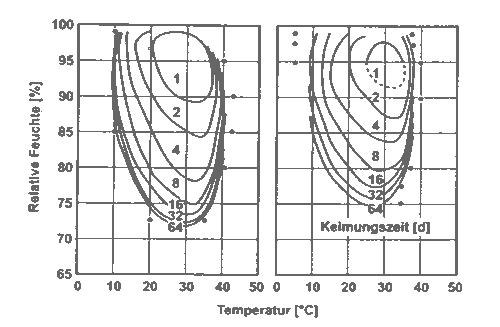
The temperature influences the metabolism, the nutrient-claims, the biomass-composition of the cell and above all the growth-speed of the microorganisms. If the temperature lies 10-25ºC below the temperature-optimum, slows down so induces the transportation-FTAM processes and the growth-speed itself in direction zero. A temperature-increase in the optimal area causes a disproportionate increase of the growth-speed on the other hand. In the practice, this becomes clear, why in a building with approaching same relative humidity and utilization-performance in 5 apartments no and in an apartment mold-affection is determined. Here, temperature-differences of 2-3 K can be available. This fact is taken into account also in the following Isoplethensystem. (Detailed explanation of the mold-book)
Picture: Isoplethensysteme for spore-end-germination of the molds (Aspergillus restrictus (left)) and Aspergillus versicolor (right). [1]
Picture: Temperature-influx on the growth-speed of microorganisms Explanation about the growth-curve:
Minimum jelly-good membrane, slow transportation-FTAM process
Optimally maximum speed of the enzymatic reaction
Maximum protein-denaturation, crash of the Cytoplasmamembran, thermic lysis
Regarding its claims at optimal temperature-conditions, microorganisms behave very differently. One distinguishes the molds by its optimal growth-temperatures, mesophile molds for 25-35ºC, thermo-tolerant molds with 30-40ºC and thermophil molds with 35-55ºC (Max). about. 60ºC, [13] completed should become the division with the psychrophilen organisms (under 0ºC until 20ºC), to this bacterias and ferric-bacterias are fitting navy predominantly. Thermophil bacterias reach its border with 70ºC and extremely thermophil organisms between 80-90ºC (for example kinds Bacillus and Clostridium), bacterias this above 90 and 100ºC grows one names hyper-thermophil organisms. [12b]
The interaction between dampness, temperature and food-substance is represented in the Isoplethensystem for spore-end-germination of the molds. Detailed references to the mold-book.
*)Name for synthetic materials, that consist of polymerisierten links of the acrylic acid and/or the methacrylic acid. Acrylic acid is the simplest unsatisfied Karbonsäure.
[1] Smith, S.L.; Hill, S. T.: Influence of temperature and water activity on germination and growth of Aspergillus restrictus and Aspergillus versicolor. Transoctions of Brtish Mycological high society Vol. 79 (1982), H. 3, S. 558 - 560
© ib-rauch.de | AGB/Data protection | 10/2005 