All fungi, which show also a series of ecological mutualities mainly morphologic, however, are called molds.
They distinguish yourself in that they have a cotton wool-shaped one, fädrigen or powdery look (moldy) on the surface. This is caused since the growth takes place not only in the material-inside but at the surface. However, there are also bacterias, who show a fungous look with the growth. To this, the so-called radiation-fungi or Actinomyceten belong.
One can accentuate to the characterization of the molds:
Aspergillus and Penicillium (picture 2.1.1.) they are at the farthest spread molds. They belong family Eurotiaceae Euascomycetidae, order Eurotiales, to the department Eumycota (real fungi), class Ascomycetes (hose-fungus), lower class. All is milk unda Saprotrophe, therefore fungi, which lives from dead, perished or artificially synthesized organic substrates, for example on food, like bread, fruits, itself. The fungi develop a quite typical real Myzel which richly is branched and stretches in the substrate or on its surface.
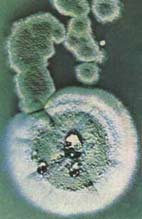 Form 2.1.1.: Penicillium (brush-mold) [7]
Its augmentation takes place almost exclusively through asexual Mitosporen (anamorphe Fruktifikation), through formation of endospores (Sporangiosporen) or exospores (conidiums), occasionally Chlamydosporen. The conidium-bearers are quite typically shaped in each case and offer the most important differences. So, the conidium-forming hyphas finish in a blister, that is intensively covered with small rod-shaped unicellular organs and Sterigmen is called, with Aspergillus. The conidium-bearers of Penicillium branch at the apex in thin little branch. Everyone this little branch carries a Sterigma, that becomes bekrönt from a conidium-chain. The Myzel is more or less colourless. The conidiums carry dyes, that its specific coloring the fungus-colony, black, brown, green, yellow or white with Aspergillus and primarily blue-green with Penicillium (also green-mold), lends. With Aspergillus, the tone of trace elements is dependent in the found substrate. for example Aspergillus nieger colors intensively black (also black-mold), if copper is present, otherwise it assumes a light yellow coloring. [8] Since the reproduction takes place almost exclusively through the above named conidiums, no showy fruit-bodies are produced. If at all sexual reproductive organs are formed, then only minutely small.
Gets Zellsprossung and formation of sprout-cells, as they characterize yeasts or yeast-similar fungi, only in quite rare cases under certain conditions.
Its habitat is the ground preferentially, also other habitats are able to conquer, like moist spaces or climate-zones. [9] includes links with boiling points of 0 - 250 ºC the characteristically transient metabolites of mold MVOC (Microbial Volatile Organic Compounds) and can be assigned a wide spectrum of different chemical material-classes, like for example the alkanols, Alkenolen, ketones, Terpenes, Aldehydes, alkanes, sulfurous links, Ethenen, ester, Karbonsäuren unda. It became about until 2001. 30 such links in interiors and in the outside-air proved, that can be formed by molds. [10]
The musty smell is to frequently be led back on the formation of MVOC through molds or bacterias. Following spectrum of links is characteristics:
3-methyl-furan, Geosmin, 1-Octen-3-ol, 3-methyl-1-butanol, 2-Pentanol, 2-Hexanon, 2-Heptanon, 3-Octanon and dimethyl-disulfide. [10] in higher concentrations shows a toxic effect some MVOC. In the interiors, low values, that don't contribute to any health encroachment, usually are available. The meaning of the MVOC is not yet sufficiently explored. [11] It, to also heed, is, that all transient metabolites, that are produced by microorganisms, don't come only from microbial origin. You/they are produced also by plants, is element of aroma-materials and technical solvents.
© ib-rauch.de | E-Mail | 10/2005